Student’s question:
Hi David,
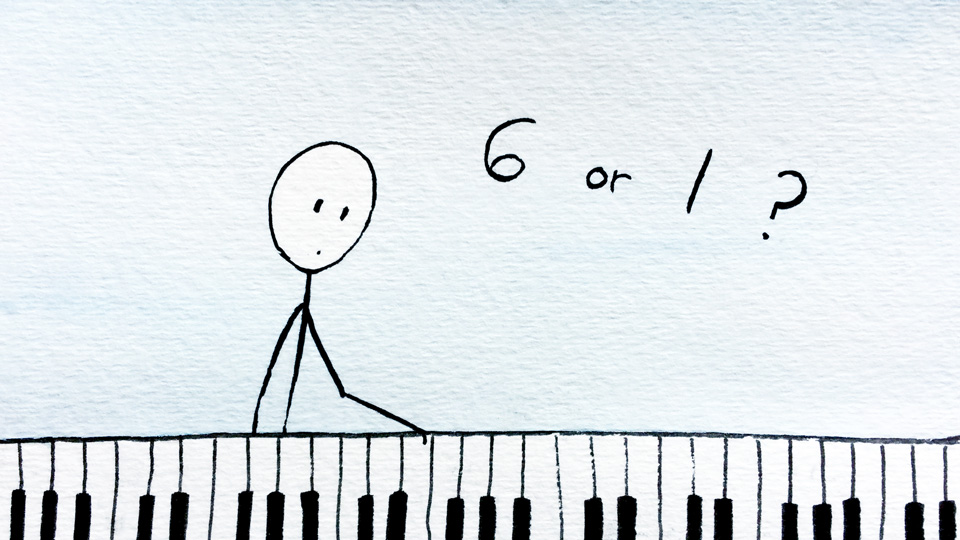
I’ve only watched the free videos on your YouTube channel but I have found them very interesting to say the least. I have a question about how you talk about minor keys. When a song is in a minor key, I noticed that you call the root “note 6” instead of “note 1”. Why wouldn’t we call it note 1?
Thank you,
Lucas
David’s response:
Hi Lucas,
I understand your concern because in your mind you’re equating “note 1” with the “tonal center” (the note that feels like home). But in most songs the tonal center is changing constantly. So if you always need to call each new tonal center your “note 1”, you’re inserting lots of artificial key changes into your thinking and this totally breaks the connection with your ear.
You also miss out on the incredible simplicity of most songs. In almost every one of these songs that sound like they’re in a “minor key” to your ear, all that’s happening is that the song spends a lot of time in the 6- chord.
As improvisers, we always want to see the entire musical landscape at once. What you’re describing as a “minor key” is really nothing more than the 6- chord. So learning to see this is an important part of understanding and mastering modern harmony.
Where this tonal point of view really pays off is when you begin to work with chord progressions that spend time in BOTH the major and minor tonal centers. For example, watch how effortlessly we can weave melodies through the chord progression to Autumn Leaves with this global vision of the musical landscape.
We also don’t lose our ability to appreciate the “minor scale” within our 6- chord. But by learning to see WHERE all of these sounds are actually located in the key of the music, we can access all of these sounds in our improvising without having to mentally change keys.
Thanks for the great question,
David