Student’s question:
Could you explain the relationship between the key, the tonal center and the chords? I know these are all different, but I’m having trouble picturing everything in my mind.
How we think about this in IFR:
Absolutely! We actually need to add one more element to our summary which is the melody. The most important thing to appreciate about these four elements is how frequently they change over the course of a song. Here is a summary of these four elements, presented from most constant to most changing:
1) The “key of the music” refers to the overall set of notes from which the song is made. In almost all popular music, this is very easy to identify because upwards of 95% of the notes will come from a single major scale. So our ear quickly orients itself in this scale, feels these seven notes as the key of the music, and perceives all other notes as “outside notes”. The key of the music is the most stable element because the key of the music rarely changes. There are songs which employ genuine key changes, but these happen relatively infrequently. So as a basic strategy for learning to understand songs, it’s good to start with the assumption that the key of the music is usually not going to change during a song. This is the origin of our IFR Tonal Map concept. Occasionally we do have to pick up our tonal map and drag it to a new location because the key of the music has legitimately changed. But it’s astonishing how often you can simply lay your tonal map in one place for the entire duration of a song and easily identify every note and chord being played.
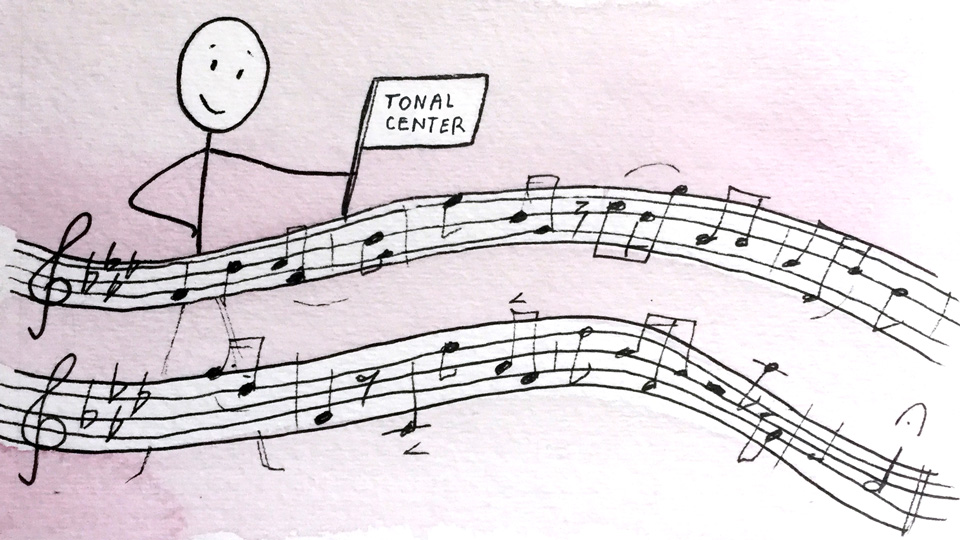
2) The “tonal center” refers to the note that feels like “home” at any given moment. At any given moment during a piece of music, if you were to pause the music and explore the sounds in your own mind, you would notice that one of these notes feels more resolved than all of the others. This isn’t necessarily note 1 from your tonal map. It could be note 6. It could be note 2. It could be anything. But the important detail about tonal centers is that they typically change over the course of a song. Some songs do have just one tonal center throughout (usually either note 1 or note 6). But there are many more songs that take us on a longer journey, and this almost always involves taking us to other tonal centers. This can often happen in what we call the “bridge” to a song. But it can also happen even more often than that, with the tonal center changing every few measures or so. So this parameter is less stable than the key of the music, and you should be prepared for the tonal center to change a few times over the course of a song.
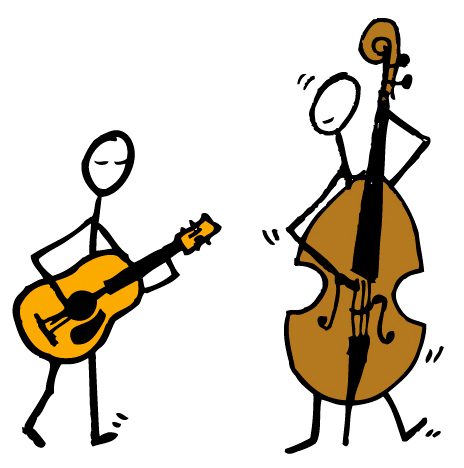
3) The “chord” refers to the harmonic accompaniment in the background. This parameter is even less stable than the tonal center, because chords in the background can change even while we continue to feel a single note as our tonal center. For example, over the course of a 2-5-1 chord progression, you’ll be feeling an attraction toward note 1 as your tonal center the whole time. So a good way to think about chords is that they are the background colors behind our melodic improvisation. In popular songs, chords are changing constantly. They are part of the engine of movement that drives the song forward. A typical pace of chord changes is to have a new chord for each measure.
4) The “melody note” refers to a single note being expressed very prominently in the foreground. This melody is the musical story that is the primary focus of the listener’s attention. As we are listening to these melody notes, we can feel how each note stands out against the harmonic background (the chord), and we can also feel the strain between the melody note and the tonal center. As I’m sure you know, the melody note is the least stable parameter of all. Each measure of a song can contain several melody notes, so this is the sound that is changing most frequently, and it’s the primary musical narration taking place.
I hope that doesn’t feel overwhelming. Let me assure you that you can also improvise beautiful music without ever consciously thinking about any of these things. So please don’t feel that you need to consciously memorize any of this or think about it when you are playing. I just wanted to explain how we use these terms, because they do come up often. And possibly you will find it somewhat helpful or enlightening to reflect on these different aspects of harmony, especially if it helps you notice and put words to sensations that you already experience when you listen to music.
Here’s a faster summary of these four elements, now in the opposite order:
1) Melody. This is moving the most, creating the main story in the music. Each new note is melodic movement.
2) Chords. This moves less often, usually about once per measure, creating the backdrop behind your melody.
3) Tonal Center. This moves even less often, perhaps once every few measures, creating the context for the melodies and chords.
And if you want to be totally complete in your vision, you can add a fourth kind of movement to your thinking:
4) Overall Key. This doesn’t even move in most songs. But maybe in about 1% of jazz standards, it’s helpful to analyze a moment as s genuine key change where we would “move our 1”.
Hope that helps bring some order to all of this!