Student’s question:
I think the tonal map is a brilliant way to introduce beginners to chord progressions. It’s so nice to be able to jump right into improvising melodically without having to suffer through years of music theory. But aren’t there limits to this approach? How will we access the more advanced sounds of jazz improvising with this approach?
How we think about this in IFR:
It’s true that the IFR Tonal Map is easier for beginners to understand than a set of rules about chord/scale theory. But there’s actually no limit to the amount of detail or complexity that we can bring onto this map. So the visual analysis that we’re performing with the IFR Tonal Map isn’t just for the basics. We can use this same visual workspace to study any scale or chord concept in the world.
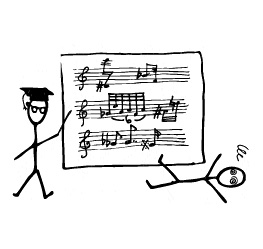
It’s not so much a question of basic vs. advanced. It’s more a question of graphical vs. formulaic. The way most people teach harmony is like the way they teach algebra. There are a lot of words written on the page, and harmonic concepts are expressed in symbols and formulas. The student memorizes these definitions and formulas, and consults these formulas to make decisions about which notes to play in different musical situations.
The tonal map represents all of this same information in a graphical format. But this doesn’t impose any limitations on the sophistication of our music. If you like the left-brained jazz theory about painting different scales over the chords, you can actually bring ALL of these concepts onto your tonal map!
I don’t know if you’re old enough to remember a time when computers were only text. People had to type every instruction into a computer using something called the “command line interface”. It all looked very serious and complicated, and there was a certain romance to it. Then something called the Apple Macintosh came along (and later Windows), and at first there was a huge backlash against these graphical user interfaces. They seemed to go against the whole ethos of computer programming. They looked more like a video game or a child’s toy. Manipulating objects by “dragging and dropping” them felt precarious and clumsy compared to the precision of typing instructions into the command line.
But where are we today? Does anyone doubt the power of a modern MacBook Pro compared to those old text-based computers of the early 80s? No, obviously not. Our modern computers can do anything that those old computers could do, plus a million things more. So that’s really all we’re doing with the IFR Tonal Map. It’s not about simplifying. It’s about upgrading.
Specifically, we’re upgrading to a visual model of harmony that allows us to actually see how notes and chords interact on the musical landscape. And by bringing all of the scales and chords onto a single map, we finally have a tool for visualizing what our ear is already perceiving naturally when we listen to music. This is why the tonal map is such a powerful tool for connecting our ear, our imagination and our instrument.
And as you grow in your harmonic vocabulary, you’ll see that there’s no limit to the complexity of concepts that we can represent on the tonal map. Again, it’s not about basic vs. advanced. It’s about replacing all those definitions and formulas with a visual workspace that displays the same information graphically.