Student’s question:
Hi David,
I’ve been experimenting with your method for improvising for a few months now and it’s really starting to click. I was improvising over a progression today, and I eventually figured out that it had the following chords:
| E | G#7 | C#m | F# | B | A |
I found that I had to listen to the progression between 5-10 times before I could recognize the chords. Is this normal? Does it just come down to practice, or should I be able to do this instantly?
Thanks!
Karl
David’s response:
Hi Karl,
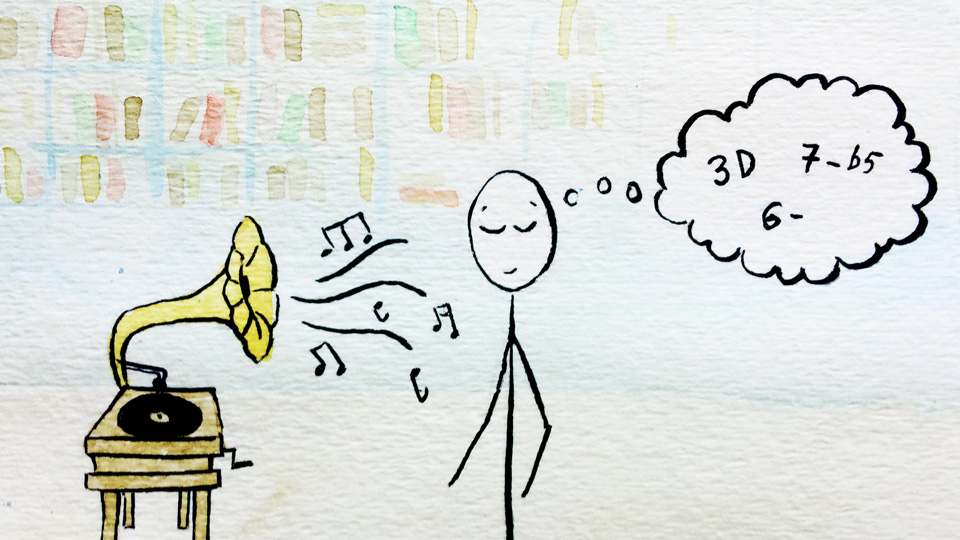
If you add each new chord to your repertoire in the right way then you’ll be able to recognize them instantly. What’s deceptive is that the chord symbols you mentioned (E, G#7, C#m, etc.) are not actually what we’re recognizing. What we recognize is the harmonic function of each chord. This is how our ear works naturally, and it’s why everyone in the audience is able to enjoy these chords in the first place. So the first thing you need to do is change your vocabulary and start doing all your thinking in tonal numbers like we do in IFR.
When you begin thinking in tonal numbers, you can immediately recognize that all of the chords you mentioned are among the most common chords in popular music. These are chords that every IFR student learns to recognize by ear. We call these chords 1, 3D, 6-, 2D, 5D, 4. Notice that every single one of these chords is built on one of the seven notes of the major scale. This is how we’re able to recognize chords by ear.
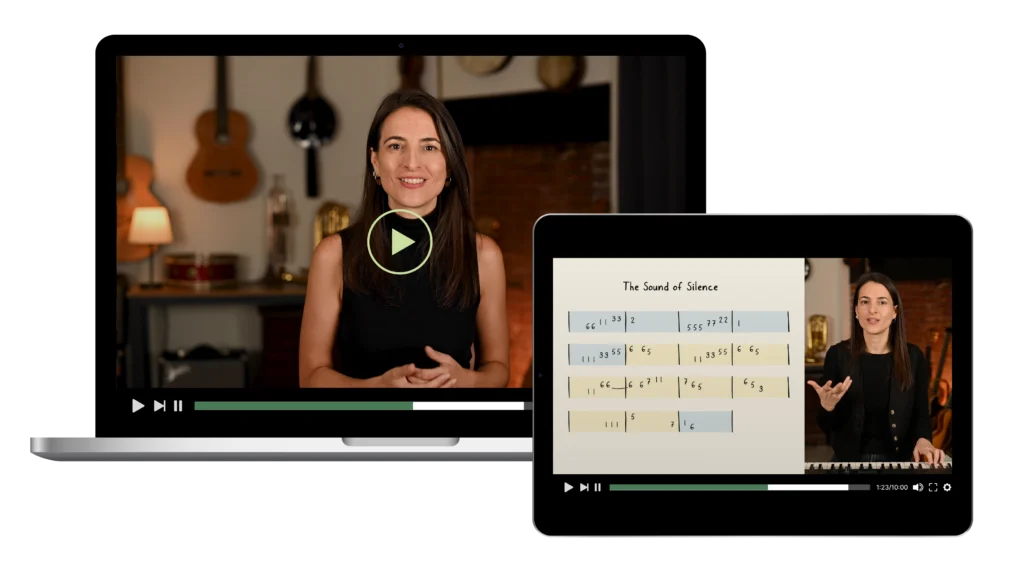
So just by practicing the IFR method, you will definitely learn to recognize chord progressions like this one by ear. And if you want to greatly accelerate this ability, I recommend our very popular video course Recognizing Chords by Ear.
In this course you’ll learn how to study chords in a way that makes recognizing them by ear a natural part of your ability. You’ll learn to recognize both the overall sensation of each chord (which comes from its harmonic function), and also the inner workings of the notes (revealed by the melodies that you can hear in the chords themselves). You’ll also get to experiment with these chords yourself, harmonizing melodies with different chords so that you can feel their effects for yourself. And of course there are lots of jamming activities and creative exercises, all focused on helping you become deeply familiar with the chords so that you recognize them instantly by ear.
So if recognizing chords by ear is important to you, my advice is to first learn the skill itself and understand how you can study any new chord in a way that gives you this ability automatically. Then you can take this new focus with you as you progress through your IFR journey. All of the chords you mentioned are part of the IFR learning path. In fact, every one of these chords is covered in IFR Jam Tracks Level 4: Mixed Harmony Essentials. Once you know the skill of recognizing chords by ear, and you know how to study chords in a way that makes recognizing them by ear a natural part of your music ability, you’ll have this ability automatically for every new chord that you study.
David
The ear training program that actually works
The ear training program that actually works
Thousands of musicians have tried every ear training method out there. Our ear training program is the one they come back to — and the one they won’t stop recommending.