Student’s question:
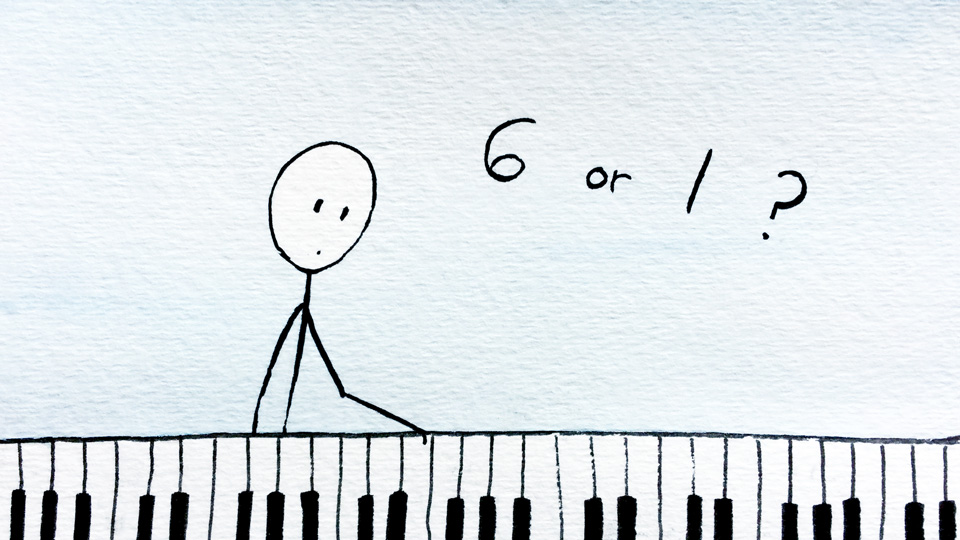
In your analysis of Autumn Leaves, you have the song ending in the 6- chord. But to my ear, this is clearly the “one chord”. Are you saying that we shouldn’t feel that final minor chord as the tonal center?
How we think about this in IFR:
No, not at all. I think everybody feels that final 6- chord as the tonal center!
But this is not the same thing as being the 1 chord. These are two different concepts. So all we’re really talking about is a certain emotional resistance to calling your tonal center “note 6” or any other note other than 1. You’re accustomed to using the term “note 1” to refer to the note that you’re feeling attraction to as the tonal center. So in your mind, these two concepts are synonyms. Whatever note we’re feeling as the tonal center simply must be called “note 1”.
But if you can just decouple these two ideas, the benefits are enormous. Suddenly you can visualize entire chord progressions like Autumn Leaves on a single map of the musical landscape, without having to mentally change keys every time the tonal center shifts to one place or another.
And when you get to more advanced songs, this will become even more important. Not only will the tonal center be shifting more frequently, but in many cases the tonal center will actually be ambiguous, meaning that two different people might argue about which chord feels most like “home”.
But as improvisers, we can always find a way to visualize ALL of the sounds on a single tonal map. We just need to decouple these two ideas of “note 1” vs. the “tonal center”. Our placement of note 1 is decided by the total collection of sounds that make up the composition. And even this decision is subjective! But in deciding which note to call our note 1, we’re just trying to come up with the best way of thinking about the song as a whole. Where can I place my note 1 so that most of the chords work out to be familiar concepts like the 2- chord, the 5D chord, and so on?
Meanwhile the concept of a tonal center refers to passing sensations that we’re going to feel as we go through the piece. There is absolutely no contradiction in calling that final chord of Autumn Leaves the “6- chord” even though it’s clearly the tonal center. Remember, ANY note on your tonal map can act as the tonal center.
So what we’re really saying is that our experience of a “tonal center” should be viewed as a phenomenon that takes place within a key, rather than the start of a new key. I realize that this idea is new to you, and I can appreciate that it might feel odd to embrace the idea that our tonal center doesn’t need to be called “note 1”. But if you can separate these two ideas in your mind, you can enjoy a vastly more powerful vision of the musical landscape that allows you to picture the entire harmonic flow of a song like Autumn Leaves without ever having to mentally change keys.