Student’s question:
I already know the note names on my instrument, and I know all of the major scales, major and minor chords, etc. Do I still need the tonal numbers?
How we approach this in IFR:
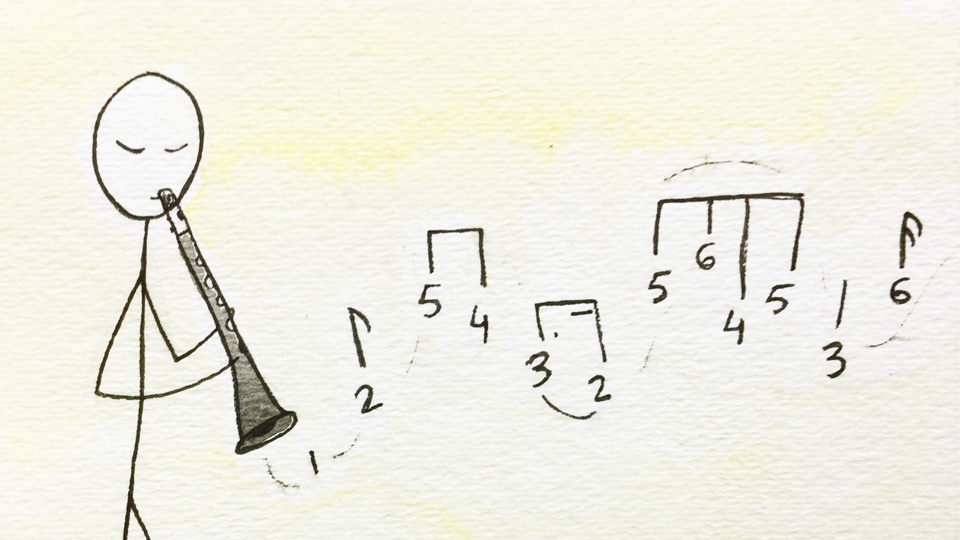
Yes, absolutely. The tonal numbers are not just a tool for building major scales. They are the essential language of harmonic analysis. It’s wonderful that you already know the note names and that you are able to use that system for thinking about musical ideas. But because any musical idea can be expressed in all 12 keys, we need a way of talking about these musical ideas that doesn’t require us to describe everything 12 different ways.
Here’s how to think about these two different concepts. The tonal numbers are the language we use to describe any musical idea in itself. This could be a melody, a scale, a chord, an entire progression, etc. But it’s a unique tonal sensation that is available to us in any key. So we need a language for talking about these sounds that isn’t bound to a single arbitrary key.
By contrast, the absolute note names refer to exact pitches on your instrument. These names are inflexible, and they don’t reveal anything at all about the harmonic function of a note or chord. They represent only a single manifestation of a musical idea. They can tell us how to play that musical idea in one key, but this is only one possibility out of twelve. This is why the absolute note names cannot serve us as a language for talking about musical concepts in themselves.
So yes, please think of the tonal numbers as primary, and please think about ways to cultivate this awareness of the tonal numbers in your mind at all times. As soon as you get a little farther into your improvisation practice, I think you’ll agree that any other way of talking about the notes would fail to describe what we’re actually talking about.
I also want to reassure you that very soon, all of this is going to be very easy for you. The tonal numbers are never going to move or change. If you live to be 100 years old, there will still be only a half step between notes 3 and 4. And in the future you’ll be making frequent use of the notes outside the key as well. So very soon, the outside notes will not be just anonymous little black dots in your mind. They will have proper names like #4, and you will come to love and appreciate each one of them.
I think it can’t be overstated how easy it is to get to know even a rich and complex space if you live there every day. (The layout of your house contains vastly more detail than our tonal map drawing.) So you don’t even need to worry about trying to accelerate your learning of this tonal space. Just enjoying your IFR practice every day is all you need in order to become deeply familiar with the tonal landscape. But the tonal numbers are essential to this learning.