Student’s question:
I am a cellist and am wondering which of your video lessons I should use for learning the IFR core skills. I guess my instrument is closest to the bass, so should I follow your bass lessons on the Cloud and Mobility techniques? I’m struggling with how I could actually execute those movements on my cello because they involve so many position shifts.
I also have a question about improvising with half steps. To do this on the cello requires a position shift on each string, which is quite challenging. Is this the point of the exercise?
David’s response:
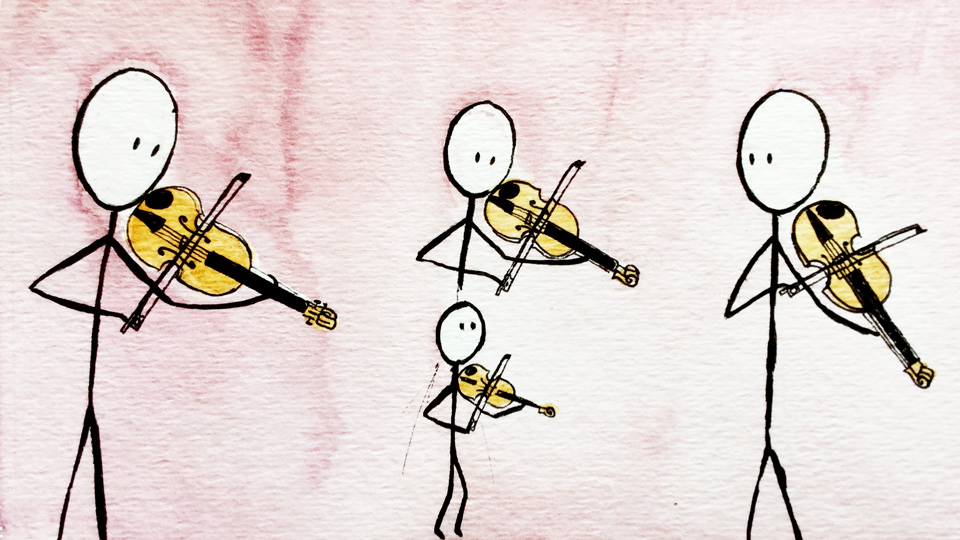
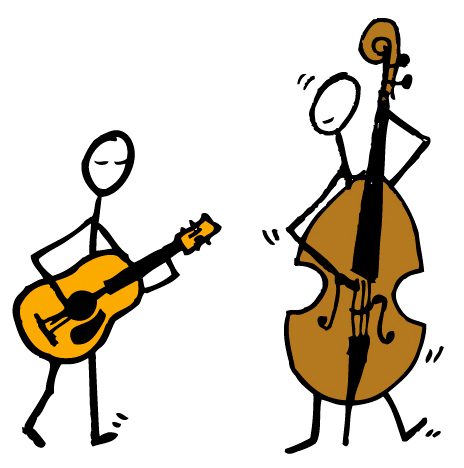
What’s special about the bowed string instruments is the elaborate technique that you need to develop in order to place each finger in exactly the right spot on the fingerboard. Guitarists and bassists don’t have to worry about this because they have frets to lock each note into place. This is why on the guitar or bass, we can be much more liberal about shifting positions. For any note on our fretboard, it’s just as easy for us to play that note with any finger on our left hand. This makes it possible to move around the entire fretboard using the Cloud and Mobility techniques that you’re asking about.
But this isn’t true for bowed string players. Because intonation is such a central issue for these instruments, your decisions about hand placement are much more thoughtful than the decisions of a guitarist. Every note on your fingerboard requires a specific technique that is built up over years of practice. And shifting positions is a whole field of study in itself.
For this reason, your thought process is really much more like a brass or woodwind instrument. You always know the name of each note you’re playing, and each note on your instrument requires its own specific technique and approach. So the best place for you to develop your foundation in the IFR method is with our video lessons for melodic instruments. Even though your instrument may physically resemble a guitar or a bass, the way you play your instrument is really much more like all of the other melodic instruments.
You’re also raising a good point about the perfect 5ths tuning which puts seven half steps on each string, and the challenges that this raises for playing through these notes smoothly. But the most important thing we’re trying to get out of the IFR Core Skills isn’t any sort of virtuoso ability with the chromatic scale. All we’re trying to take away is a clear understanding of the harmonic relationships on your fingerboard. So just play slowly and try to use everything you already know about your instrument to make those position shifts when you need to. And remember that the most important benefit of our half steps and whole steps practice is just learning to see the musical landscape more clearly. As soon as you move on to Seven Worlds, you’ll find yourself improvising with scales that feel much more familiar under your fingertips.