Student’s question:
When soloing over the IFR Jam Tracks, should we be mindful only of the sound of the notes we are playing without thinking of the chords in the progression? Also, as we are soloing, should we be thinking of the tonal numbers and equating them with the sounds?
How we approach this in IFR:
These are two great questions and I would propose different answers:
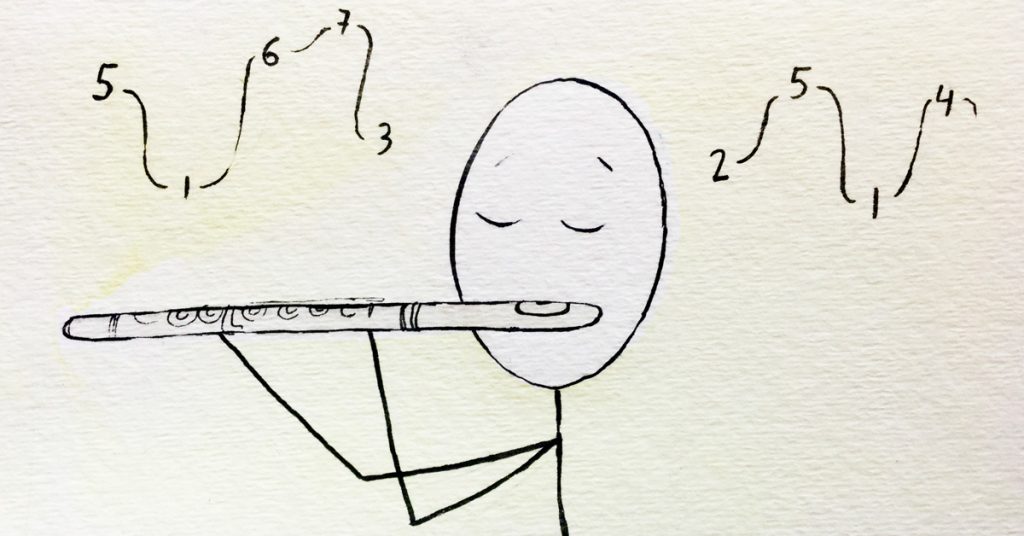
1) Must you think consciously about the chords and chord notes while you are improvising? Not necessarily. Musical learning happens on many levels but most of it takes place in the subconscious. What this means is that even when you’re not thinking consciously about the chords, on a deeper level your mind is totally aware of these chord changes because you’re feeling the push of the harmony just like everyone in the audience. And if you’re listening deeply to each note you play, you’re already perfectly aware of which notes deliver a pleasing sensation of relaxation, and which ones seem to open a new conversation loop by creating tension.
So for example, if you can hear very clearly in your mind that you want to end your melodic phrase on note 6, ultimately it makes no difference WHY you’re craving note 6. Quite possibly it’s because the music is about to arrive to the 4 chord, and note 6 is a chord note of this chord. But you didn’t need that information in order to know which sound you wanted to hear. This is an example of playing directly from your imagination, listening only to your inner composer. This is one of the most beautiful improvisation experiences I know, and it’s a perfectly valid way to practice your creative exploration of the sounds. (And we have plenty of other activities to help you learn which notes belong to each chord. So you don’t need to be constantly rehearsing that information.)
2) Should you think consciously about the tonal numbers you’re playing? Absolutely. This is an awareness that we need to cultivate consciously until it’s become so ingrained in our thinking that it’s automatic. Think of this like teaching a child the concepts of “right” and “left”. At some point the child learns these two concepts so deeply that he/she no longer needs to practice this skill consciously. The concept is simply at the child’s disposal and the knowledge has become unconscious. So even when we’re not consciously saying the words “right” and “left” in our minds, we’re always aware of which direction is which. We need to get to this same place with the tonal numbers. You can stop thinking about them when they have become so unconscious and automatic for you that you simply ALWAYS know which tonal number you’re playing.
One of the ways to get there is to prioritize the ear training activities like our Sing the Numbers course. This is what saves us from having to “remember” which tonal number we’re playing, because we can hear it. In the beginning of our IFR journey, we need to invest effort to learn these connections. But eventually, the knowledge of which note we’re playing becomes just as intuitive and obvious to us as the difference between right and left. And this is an important part of staying oriented in the key of the music, which is essential to knowing how to express the sounds we imagine. So my advice would be to practice the discipline of always knowing exactly which tonal number you’re playing at all times.